

The Supreme Court’s Impact on American Law: Landmark Cases and Decisions
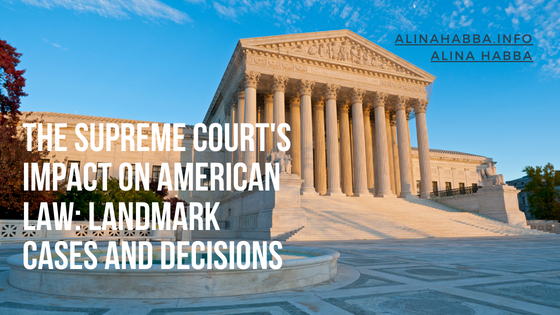
The Supreme Court of the United States, the highest judicial body in the nation, plays a pivotal role in shaping American law. Through landmark cases and decisions, the Court interprets the Constitution, resolves legal disputes, and establishes precedents that have far-reaching consequences for the nation. This blog explores the profound impact of the Supreme Court on American law by examining some of its most influential decisions.
Landmark Cases:
Brown v. Board of Education (1954):
A watershed moment in American legal history, Brown v. Board of Education declared state laws establishing separate public schools for black and white students to be unconstitutional. This unanimous decision overturned the infamous “separate but equal” doctrine established in Plessy v. Ferguson (1896), marking a significant stride towards desegregation and the promotion of equal rights for all.
Roe v. Wade (1973):
In Roe v. Wade, the Supreme Court recognized a woman’s constitutional right to choose to have an abortion, striking down state laws that criminalized or restricted access to the procedure. This decision fundamentally shaped reproductive rights in the United States and sparked ongoing debates over the balance between a woman’s autonomy and the state’s interest in protecting potential life.
Marbury v. Madison (1803):
Often regarded as the case that established the principle of judicial review, Marbury v. Madison solidified the Supreme Court’s authority to interpret the Constitution and determine the constitutionality of laws. Chief Justice John Marshall’s opinion in this case laid the foundation for the Court’s role in checking the powers of the other branches of government.
Decisions that Shaped Constitutional Interpretation:
Miranda v. Arizona (1966):
The Miranda decision established the requirement for law enforcement to inform individuals of their constitutional rights upon arrest. The famous Miranda warning, including the right to remain silent and the right to an attorney, has become a staple in criminal proceedings, ensuring that individuals are aware of and can exercise their rights during police interrogations.
Gideon v. Wainwright (1963):
Gideon v. Wainwright expanded the right to counsel by holding that states must provide legal representation to defendants who cannot afford it. This landmark decision significantly impacted criminal justice procedures, ensuring that the accused have adequate legal representation, a principle that remains crucial to the fairness of the legal system.
The Supreme Court’s impact on American law is profound and enduring. Landmark cases and decisions have shaped the course of the nation’s legal landscape, influencing civil rights, individual liberties, and the balance of power among government branches. As the Court continues to grapple with contemporary issues, its decisions will undoubtedly play a crucial role in defining the evolving contours of American law.
BusinessMore posts from Alina Habba
View posts
Mastering Strategic Thinking: A Blueprint for Long-Term Leadership Success
Alina Habba · In the ever-evolving landscape of business, leaders face the formidable challenge of steering their organizations toward long-term success. Strategic thinking, a crucial skill for effective leadership, enables leaders to anticipate future trends, make informed decisions, and posi ...

Law and Popular Culture: Examining Legal Themes in Movies and TV Shows
Alina Habba · Law and popular culture intersect in fascinating ways, offering audiences a glimpse into the legal world through the lens of entertainment. From courtroom dramas to crime thrillers, movies, and TV shows have been exploring legal themes for decades, captivating audiences with rive ...

Copyright vs. Trademark: Understanding the Differences and Why They Matter
Alina Habba · In the vast landscape of intellectual property, two terms often cause confusion: copyright and trademark. While both are crucial for protecting creative works, they serve distinct purposes and cover different aspects of intellectual property law. Understanding the differences bet ...
Articles from Alina Habba
View blog
In any criminal justice system, the role of a defense attorney is essential to ensuring that the rig ...

Navigating legal issues can be intimidating, especially when considering the possibility of a courtr ...

Receiving an unfavorable court decision can be frustrating and disheartening, but it’s not always th ...
You may be interested in these jobs
-
EVERYTOWN LAW seeks two talented and creative Legal Assistants/Researchers to join our Affirmative Litigation team in May, June or July. · ...
New York, NY1 month ago
-
The Office represents the State of Florida in state and federal civil and criminal courts. · This Assistant Attorney General position is in the Office of the Attorney General within the Civil Litigation unit in Jacksonville, Florida. · Prosecute and defend civil litigation on beh ...
Jacksonville1 month ago
-
· About the role: · This prestigious American multinational law firm is known for its expertise in corporate law, litigation, and regulatory matters. Established in the mid-20th century, it has grown into one of the largest firms globally, both in revenue and number of attorneys ...
New York, New York, United States1 week ago
Comments